
April Ashley of the NEC speaking to conference. Image: Marcus Rose
At their first conference since Labour came to power, national delegates formerly welcomed one of the new government’s signature pieces of legislation, the Employment Rights Bill (ERB), which is currently working its way through Parliament.
But they also voiced their belief that “there is more to be done” to ensure that the bill meets its potential – and to fight off its opponents.
Proposing the composite motion, ‘Backing the Employment Rights Bill’, April Ashley of UNISON’s national executive council (pictured above) said: “This is an important step forward that benefits working people. And much of the ERB is UNISON policies for the workplace that we’ve been fighting for, for years. We know that with all workers’ rights we have to fight hard. They’re not given on a plate. We struggle and strike for these rights.”
She listed just some of those included in the ERB, from individual rights such as day one entitlement to sick pay and protection against unfair dismissal, family friendly rights and flexible working, to a ban on exploitative zero-hours contracts and fire and rehire, to collective rights, such as greater access to organise in workplaces, trade union recognition made easier, sector collective bargaining in schools and adult social care, and a fair work agency.
But of the Labour promise to repeal the Trade Union Act 2016, she said: “That’s great. But when is that going to happen? As the motion says, we condemn the delay in repealing the act. It should have happened immediately. The act should be repealed now. There is really no excuse.
“We also have to fight to make sure that the ERB is not watered down. We already know that the Tories and the Lib Dems are trying to water it down. It is under attack. And of course, the bosses are attacking it as well, as it goes through Parliament. And of course, the right-wing press hates anything like this – when have they ever been on our side?
“We have to make sure that the Labour government doesn’t water it down. It’s up to us, to make sure that the ERB keeps all its clauses as it goes through Parliament.
“And like all legislation, we have to ensure that the ERB is implemented in the workplace. To make it a reality on the ground, not just a paper exercise.” She said that branch activism had a key role to play in this. “Our campaign A Better Life at Work is not just a slogan, it’s a necessity for all of us.”
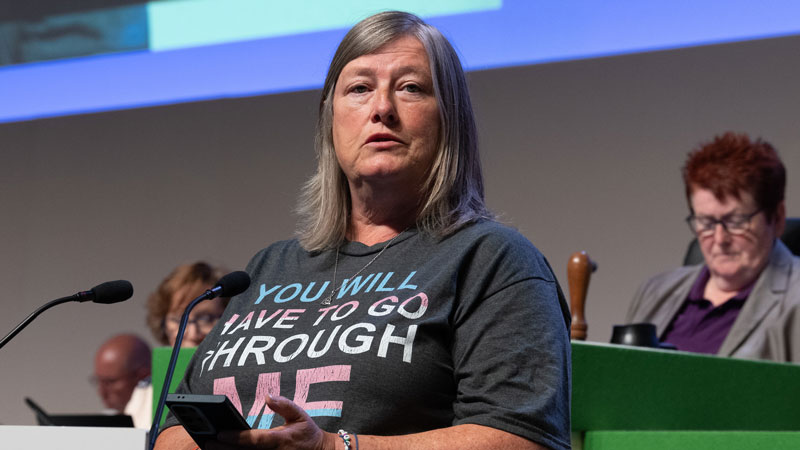
Eileen Best. Image: Marcus Rose
Many others spoke of the bill’s potential. Eileen Best, of the national LGBT+ committee said: “The Employment Rights Bill represents a vital opportunity for real, lasting equality at work. We know our workplaces don’t exist in isolation from society. LGBT+ workers, especially those who are also Black, disabled, trans or working class, face layered discrimination and systemic barriers.
“The new bill, if properly shaped, has the potential to be a turning point, it can strengthen protections against harassment, secure day-one rights for all workers, and clamp down on the use of zero-hours contracts. These are not just abstract rights, they are protections that LGBT+ workers – and all workers – need.
“Legislation, again, is not enough. We must act, and that means working directly with LGBT+ workers in shaping our campaigns, our bargaining, and our policy.”
Becky Everett of East Midlands region (pictured below) said: “This is not just a piece of legislation, it’s a turning point, a transformative moment which reshapes the environment in which our union and the wider trade union movement operates. For the first time in half a century we have a real chance to rebuild worker power. Not just in rhetoric, but in law, in practice, and in workplaces across the country.
“For too long the scales have been tilted in favour of employers. But this bill begins to change that. It removes the shackles on our right to strike, it restores access to workplaces and speeds up the process of statutory recognition. It better protects our members from dismissal for taking action and opens the door to sectoral bargaining in social care and education, something UNISON has campaigned on for years.”
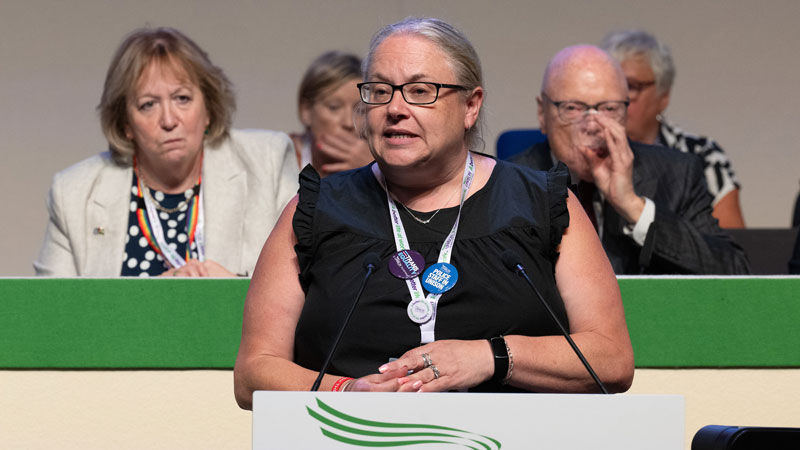
Becky Everett. Image: Marcus Rose
Ms Everett continued: “This didn’t happen by accident. This bill exists because of decades of tireless work by our union, and particularly our Labour Link. And it exists because the Labour government, true to its word, published this bill within 100 days. Credit where credit is due – this is what delivery looks like.”
But she also added “a word of warning”, stemming from Reform’s recent control of six East Midlands councils. “Already we have seen attacks on jobs, terms and conditions, and pensions. Make no mistake, they are coming for our facility time and recognition agreements next.
“So we must stay vigilant. We must fight for full and fast implementation of this bill.”

Image: Marcus Rose
One first-time delegate and first-time speaker, from Aberdeenshire (pictured above), described herself as a care worker from Nigeria who had endured a lack of rights, harassment and gaslighting at work, as well as the threat of having her sponsorship withdrawn when she dared to challenge her employer. To applause from delegates, she bravely welcomed a bill that could help to improve her lot.
Delegates passed the motion, that stated: “The bill, though transformative, must include stronger mechanisms for enforcing individual rights and enhanced powers for trade unions to address imbalances of power in workplaces effectively.
“Conference asserts that it will seek to protect the bill from the business and Tory attacks, while trying to improve measures in the bill in line with UNISON policy and leave no loopholes for avoidance, particularly for employers still willing to attempt fire and rehire.”
It also noted the pressure on Labour, from the bill’s opponents, to drop the commitment to repeal the 2016 act, and concern that the government may delay the repeal of the requirement for 50% turnouts in ballots until electronic balloting for industrial action has been introduced. “Secondary legislation necessary to implement the Employment Rights Bill must be prioritised.”
The motion also notes that the bill applies to Great Britain only, and supports the ongoing campaign by UNISON Northern Ireland for their own comprehensive new employment rights legislation.
The ERB paradox
An ERB fringe during conference allowed delegates to hear more detail about the benefits of the bill from two experts.
Professor Alan Bogg, an academic and leading employment law academic, made an initial observation, regarding a “paradox” in the bill. “On the one hand, it is without question the most ambitious piece of legislation in my memory; throughout the 20th and 21st centuries there is nothing to match the scale of the bill,” he said. “However, on the other hand, it’s starting from an incredibly low baseline.”
He used day the bill’s day one protection against unfair dismissal as an example. Of the OECD countries, the UK dismissal law is the fifth worst of the 38 member countries: currently in the UK, you have to work for two years to be entitled to basic unfair dismissal protection.
Professor Bogg, also spoke of the part of the bill that seeks to protect striking workers from detrimental treatment by employers – clauses that are a direct consequence of UNISON’s Supreme Court victory in defending its member Fiona Mercer, where he himself was one of the barristers.
“Mercer was a remarkable case. Until this case, there had not been a legal challenge to a massive gap in legal protection for strikers. Statutory protection against any form of victimisation other than dismissal was long overdue. I know of no other country in Europe where an individual would be unprotected from detriment.”
This would now be remedied through the bill, which will introduce protection from detriment, as well as remove the 12-week limitation on protection from dismissal.
“Your union brought about this change,” Professor Bogg added. “It was a privilege to be involved. Your legal department has the best lawyers in the trade union movement, without question.”
Maggi Ferncombe, UNISON’s director of political strategy and transformation, spoke about the bill’s improvements to facility time, shifting the onus away from reps having to account for every minute spent in their trade union duties, to employers having to prove why someone doesn’t need it. “Reps will no longer be working with one hand tied behind your backs,” she said, while also noting the new recognition of equality reps, who will be able to claim facility time for the first time.
Ms Ferncombe also spoke of the how the bill will improve unions’ ability to gain access and achieve recognition.
The article ‘This is not just a piece of legislation, it’s a turning point, a transformative moment’ first appeared on the UNISON National site.
Comments are closed.